For many organizations working on the frontlines of displacement, the current humanitarian funding crisis is not a new reality—it is simply a continuation of challenges they have navigated for years.
As governments and international agencies grapple with shrinking humanitarian budgets, refugee-led organizations continue doing what they have always done: responding to urgent needs, empowering communities, and creating lasting solutions with limited resources.
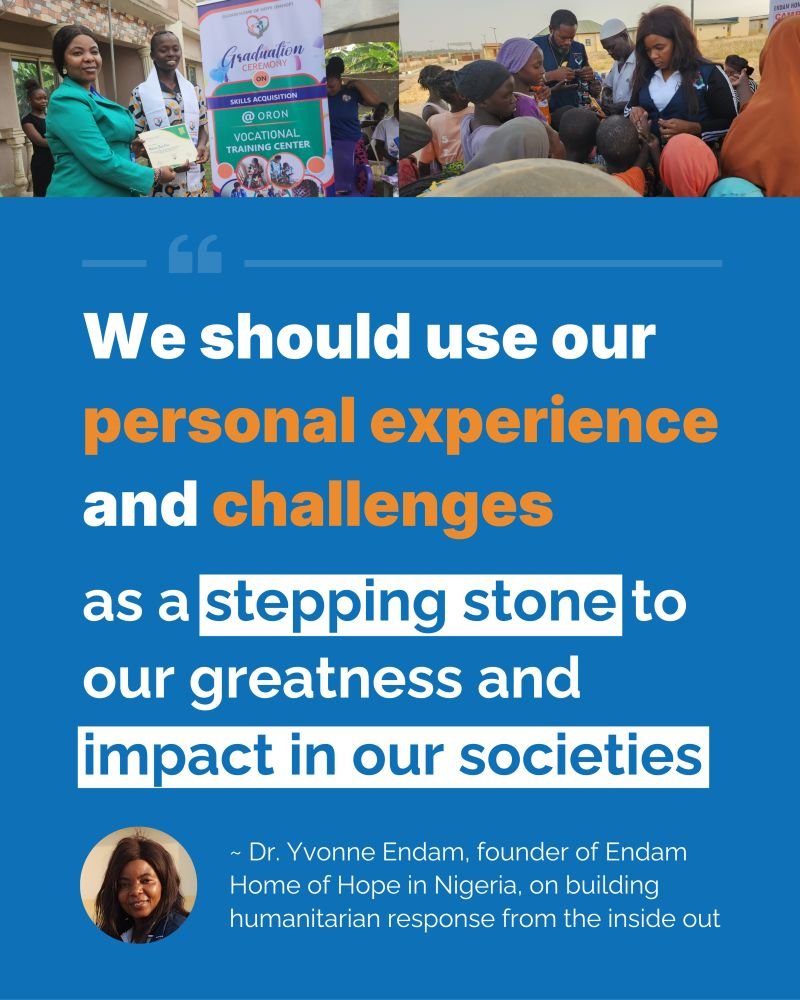
Our Founder and Executive Director, Dr. Yvonne Ndaga Endam, recently shared this perspective in a powerful feature highlighting the lived realities of refugee-led organizations in Nigeria. Since founding Endam Home of Hope (EHHOP) in 2018, Dr. Endam has led efforts to support refugees and internally displaced persons through skills development, livelihoods, protection, healthcare, education, and economic empowerment—often relying on personal commitment and locally mobilized resources rather than traditional humanitarian funding.
This story challenges an important assumption within the humanitarian sector. The question is not simply how to respond to funding cuts. It is also how to transform a system that has historically left local and refugee-led organizations at its margins.
Refugee-led organizations possess the lived experience, local trust, cultural understanding, and community relationships needed to deliver sustainable and inclusive solutions. Yet many continue to face barriers to accessing funding, participating in decision-making, and influencing humanitarian priorities.
At Endam Home of Hope, we believe that localization must move beyond policy discussions and become meaningful practice. This means investing directly in local leadership, shifting decision-making power closer to affected communities, honoring Grand Bargain commitments, and recognizing refugee-led organizations as equal partners—not just implementing agencies.
Despite limited resources, our work continues to demonstrate what community-led action can achieve. From vocational training and sustainable livelihoods to women’s empowerment, agricultural initiatives, and refugee integration, every program is built on the belief that displaced people are not passive recipients of aid—they are innovators, entrepreneurs, leaders, and changemakers.
The humanitarian sector has an opportunity to rethink how it supports frontline organizations. Sustainable impact will only be achieved when those closest to the challenges are equally close to the resources and decisions that shape humanitarian responses.
We are grateful to the International Council of Voluntary Agencies (ICVA) for providing a platform to amplify these important conversations and elevate the voices of refugee-led organizations worldwide.
Read the full story and discover why strengthening refugee-led organizations is essential for a more equitable humanitarian future.
🔗 Read the full blog here: https://lnkd.in/dp7HfDCn
Together, let us move beyond conversations about localization and invest in the leadership already transforming lives every day.
About The Author
