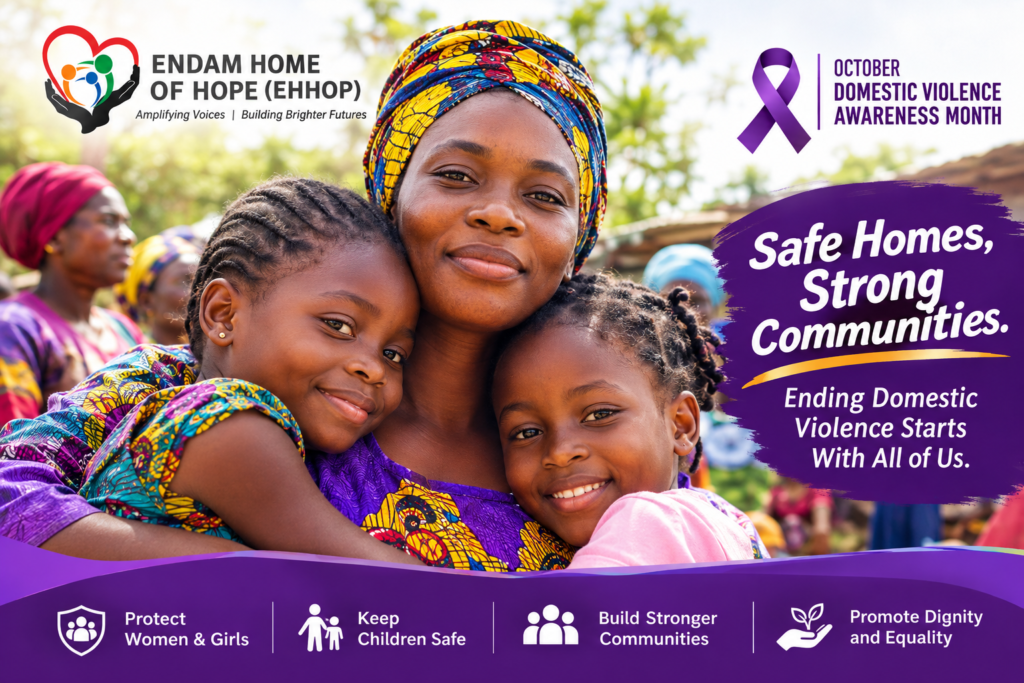
A home should be a place of safety. It should be where children feel protected, where families find support, and where women and girls can live with dignity and without fear. Yet domestic violence continues to affect millions of women and girls worldwide, including communities across West Africa and the wider African continent. October’s Domestic Violence Awareness Month provides an opportunity to move beyond awareness and ask a more important question:
What are we doing to prevent violence before it happens?
For Endam Home of Hope (EHHOP), this question is closely connected to our commitment to dignity, protection, inclusion, empowerment and resilient communities. Domestic violence is not simply a private family issue. It intersects with gender equality, human rights, child protection, health, livelihoods, education, peacebuilding and community resilience. Ending it requires collective responsibility.
What Domestic Violence Really Means
Domestic violence can take many forms. It may involve physical, sexual, psychological or emotional violence, economic abuse or controlling behaviours by a current or former intimate partner or another person within a family or household context. Some forms of violence are visible, others are hidden.
This is why awareness matters.
The World Health Organization defines intimate-partner violence as behaviour by a current or former partner that causes physical, sexual or psychological harm, including physical aggression, sexual coercion, psychological abuse and controlling behaviours. Domestic violence should never be dismissed as a normal part of relationships, marriage or family life, nor should responsibility ever be placed on the person experiencing violence.
The responsibility belongs to the person who chooses to use violence.
The African and West African Reality
The scale of violence against women and girls is global, but the evidence shows particularly serious challenges across Africa. According to the World Health Organization’s latest estimates, approximately 1 in 3 women worldwide, around 840 million, have experienced physical and/or sexual violence by an intimate partner or non-partner during their lifetime. For Sub-Saharan Africa, WHO estimates lifetime intimate-partner violence at approximately 32%. UN Women has similarly highlighted the particularly high burden of violence against women and girls in Africa, with its ACT campaign citing an estimated 36% prevalence of physical or sexual violence among women in Africa, compared with the global average of approximately one-third. The situation is particularly important for organisations working in West Africa.
UNFPA reported that in 2024, more than 8 million women and girls in West and Central Africa required support related to gender-based violence. Among reported GBV cases in the region, intimate-partner violence accounted for 37%, while rape and sexual assault accounted for 38%. WHO’s African Region also reported a 20% prevalence of intimate-partner violence among ever-partnered women in West and Central Africa in the previous 12 months in its 2022 regional analysis.
Country-level evidence reinforces the seriousness of the challenge. For example, Senegal’s first national stand-alone survey on violence against women, published in 2025, found that 70.2% of women aged 15 and above had experienced intimate-partner violence since their first union, while 31.9% had experienced at least one form of violence during the previous 12 months. This Senegal statistic should not be interpreted as a regional average. Rather, it demonstrates why stronger and more comparable data across West Africa are essential.
UN Women has identified the scarcity and difficulty of collecting gender-specific data in West and Central Africa as an important challenge. Better data can help governments, humanitarian actors and civil society organisations design more effective prevention and protection programmes.
When Home Is Not Safe
Domestic violence affects more than the individual experiencing it. It can affect children, families, livelihoods, education, health, relationships and community cohesion. UNICEF’s recent global analysis provides an important illustration of this wider impact: approximately 1 in 4 children worldwide — around 610 million — live with mothers who have experienced intimate-partner violence, with the proportion reaching 32% in Sub-Saharan Africa, affecting approximately 187 million children.
The implications are profound. A child exposed to violence may experience fear and insecurity in the very environment that should provide protection. Families may face economic instability. Women experiencing violence may find it harder to participate in education, employment or community decision-making, and when violence becomes normalised, harmful patterns can be passed from one generation to another.
UNICEF also estimates that more than 79 million girls and women in Sub-Saharan Africa experienced rape or sexual assault before the age of 18 — more than one in five. These realities demonstrate why domestic violence and child protection cannot be treated as separate conversations.
Vulnerability During Displacement and Humanitarian Crises
West and Central Africa faces a complex combination of conflict, insecurity, displacement, poverty, climate-related shocks and chronic vulnerability. UNFPA reported that 44 million people in West and Central Africa required humanitarian assistance in 2024, amid interconnected crises involving violence, insecurity, political instability, food insecurity and climate pressures. UN Women similarly highlights how conflict, disasters, climate change and chronic vulnerabilities can exacerbate existing gender inequalities and increase risks for women and girls in the region. In such environments, access to protection, health services, livelihoods and community support can become more difficult.
But one principle must remain clear: Crisis does not cause or excuse violence.
The responsibility for violence remains with the perpetrator. Humanitarian and development responses must therefore ensure that protection considerations are integrated into programmes supporting displaced, vulnerable and crisis-affected communities. This includes strengthening community awareness, safe referral pathways, survivor-centred services and mechanisms for raising concerns safely.
Prevention Starts With Communities
Ending domestic violence requires more than responding after violence occurs. It requires prevention.
Positive social norms
Communities can challenge beliefs that excuse violence or reinforce unequal power relationships. Respect, equality and non-violent conflict resolution should be actively promoted.
Engaging men and boys
Men and boys must be part of the prevention conversation. Challenging harmful ideas about masculinity, power and relationships can contribute to healthier families and communities.
Women’s empowerment
Women and girls should have meaningful opportunities to participate in education, livelihoods, leadership and decision-making. Empowerment strengthens agency and contributes to more resilient communities.
Child protection
Children must be protected from violence in homes, schools and communities. They should grow up learning that respect, equality and non-violent relationships are fundamental values.
Education
Education can challenge harmful norms and help young people understand equality, respect and healthy relationships.
Economic empowerment
Economic vulnerability can intersect with protection risks. Expanding access to livelihoods, financial resources and economic opportunities can contribute to women’s agency and resilience.
Responsible leadership
Community leaders, government officials, educators, faith leaders and civil society organisations can influence attitudes and behaviours. Leadership must make it clear that violence is unacceptable.
Accessible support
Prevention must be accompanied by appropriate services for people experiencing violence. Health, psychosocial, legal, protection and social services should be accessible, confidential and survivor-centred. WHO and UN Women both emphasise the importance of laws, policies, prevention, services, financing and action to transform harmful gender norms.
From Awareness to Action
Awareness is important. But awareness must lead to action.
Individuals can:
- Challenge attitudes that normalise violence.
- Promote respectful relationships.
- Listen without blaming people who disclose experiences of violence.
- Encourage people to seek appropriate professional support.
Families can:
- Teach children about respect and equality.
- Create environments where children can safely communicate concerns.
- Reject violence as a method of resolving conflict.
Communities can:
- Create spaces for dialogue around gender equality and protection.
- Challenge harmful social norms.
- Strengthen community-based protection mechanisms.
- Promote awareness of appropriate referral services.
Organisations can:
- Strengthen safeguarding and protection systems.
- Train staff and volunteers to respond appropriately to disclosures.
- Protect confidentiality and dignity.
- Establish appropriate referral pathways.
- Ensure communications never blame or stigmatise survivors.
Leaders can:
- Speak clearly against domestic violence.
- Support effective policies and legislation.
- Promote gender equality.
- Invest in prevention and survivor-centred services.
- Hold institutions accountable.
EHHOP’s Commitment
At Endam Home of Hope (EHHOP), we believe that every woman, girl and child deserves to live with dignity, safety, inclusion and opportunity. Our commitment to vulnerable and crisis-affected communities is grounded in the belief that protection and empowerment are essential to sustainable development and resilient societies. We recognise that violence against women and girls cannot be addressed in isolation. It intersects with poverty, inequality, displacement, education, livelihoods, peacebuilding and community resilience.
EHHOP therefore advocates for approaches that:
Amplify voices.
Protect dignity.
Promote inclusion.
Empower women and girls.
Protect children.
Challenge harmful norms.
Strengthen resilient communities.
We also recognise that ending domestic violence requires collaboration. No single organisation, institution or community can solve this challenge alone.
A Call for Collective Action
Domestic violence should never be normal. Not in our homes. Not in our communities. Not during times of peace. And not during times of crisis. The evidence from West Africa, Sub-Saharan Africa and around the world tells us that the challenge is enormous. But evidence also tells us that prevention is possible.
The question is whether we are willing to move beyond awareness and invest in the changes required to create safer environments. This October, let us challenge silence. Let us question harmful norms. Let us engage men and boys. Let us empower women and girls. Let us strengthen child protection. Let us support survivors without judgement. Let us demand responsible leadership. And let us build communities where dignity is not negotiable.
A safe home is the foundation of a strong community.
Let October be more than a month of awareness. Let it be a month of action.
Endam Home of Hope (EHHOP)
Amplifying Voices | Building Brighter Futures
About The Author
